
Art of Korea

Crafts:
Korea produces a distinct range of handicrafts. The majority of handicrafts are made for specific everyday uses, frequently prioritising functionality over aesthetics. The primary materials used historically were metal, wood, fabric, lacquerware, and earthenware; later, glass, leather, or paper have been sporadically used.
Gilt crowns, patterned earthenware, pots, and decorations are only a few examples of the complex and intricate handicrafts that have been discovered. The Goryeo era saw a development in the use of bronze. Brass, which is composed of two-thirds copper and one-third zinc, has long been a preferred material. However, the dynasty is most well-known for its usage of celadon ceramics.
Popular handicrafts of the Joseon era were made of porcelain and painted in blue. The art of woodworking also advanced at that time. As a result, furniture including wardrobes, chests, desks, and drawers became more complex. One of Asia's and the world's greatest woodworking and design traditions may be seen in Korean furniture. It is a part of a craft that has a long history and preserves a custom that hasn't altered since at least the seventeenth century. This history has elevated Korean furniture to the top of the list of exotic furniture types sought for by global antique dealers and collectors. This distinctive art, which is instantly recognizable as Korean, was only "discovered" by the West in the late 1940s and 1950s.
Ceramics:
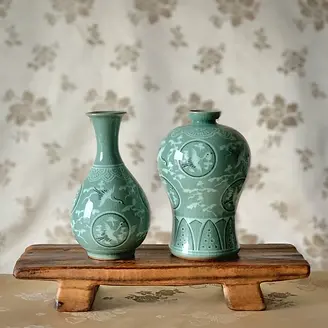
Jade green celadon ceramics rose in popularity during the Goryeo period. In the 12th century, complex inlaying techniques were developed, enabling increasingly ornate, multicoloured ornamentation. According to Evelyn McCune in Arts of Korea, The creation of ceramic ware reached its pinnacle of sophistication in the twelfth century. In the space of a quarter century, several new forms concurrently emerged, with inlaid ware being one that must be credited to Korea.
After World War II, William Bowyer Honey of the Victoria and Albert Museum in England wrote: The best pottery ever produced was not only original but also courteous and unaffected. Every pottery-related virtue is present in them. In actuality, this Korean pottery hit heights that the Chinese hardly ever did.
The 15th century saw the rise of white porcelain, which quickly replaced celadon ceramics. Copper was frequently used to paint or adorn white porcelain. Korean potters were returned to Japan during the Imjin wars in the 16th century, where they had a significant impact on Japanese pottery.
These Korean potters were seized by the Japanese during their failed attempts to conquer the Korean peninsula, and many Japanese pottery families today can trace their art and genealogy to them.
Click here to find Korean Ceramics
Paintings:
Petroglyphs, or prehistoric paintings, are the earliest artefacts discovered on the Korean peninsula. Buddhism was brought to China from India, and it introduced new methods. However, native techniques continued to exist despite these techniques' rapid emergence as the norm. Murals from the Goguryeo tomb were one of them. The artwork found inside several tombs provide priceless insights into the rituals, conflicts, buildings, and daily activities of the ancient Goguryeo people. The successor state of Goguryeo, the Balhae kingdom, incorporated many of the typical Goguryeo features.
There is a propensity toward naturalism, and typical themes include realistic landscapes, flowers, and birds. The most popular medium is ink, which is painted on either silk or mulberry paper. Sometimes there are humorous details.
Indigenous methods made significant advancements in the 18th century, particularly in calligraphy and seal engraving.
New Korean painting subgenres, such as chaekgeori (paintings of books) and munjado (paintings of letters), emerged during the Joseon era, illustrating the obsession with books and education in Korean society.
Realisticism and tradition both have an impact on the arts. For instance, Han's almost photorealistic "Break Time at the Ironworks" depicts muscular men sweltering in a hot foundry while sipping water from tin cups. "Peak Chonnyo of Mount Kumgang" by Jeong Son depicts a traditional Korean landscape with soaring cliffs cloaked in mist.
Korean paintings available here